
Soil, Water, and Toxics: The Long-Term Environmental Damage of War
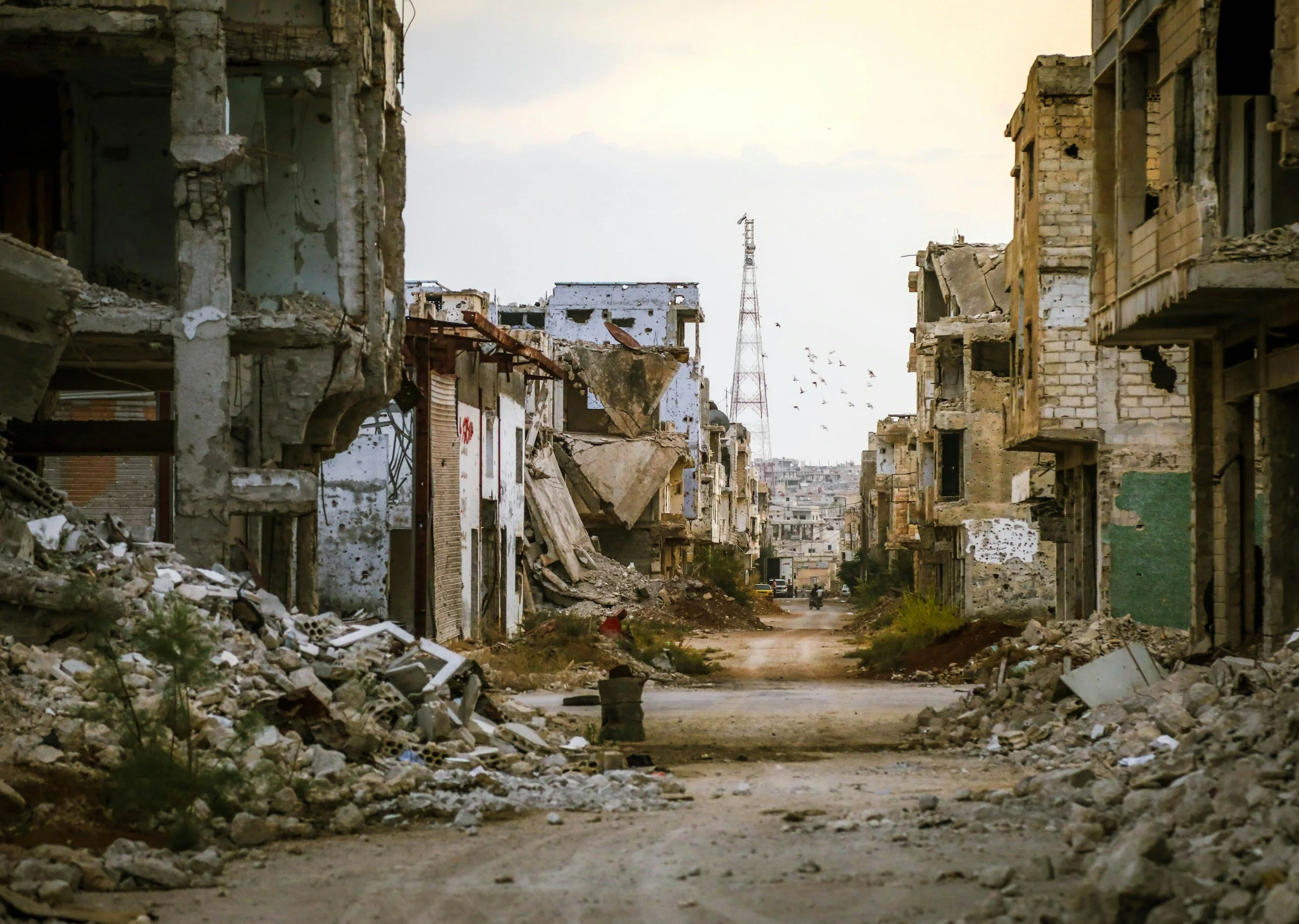
A note before we begin: the environmental consequences of war are real, lasting, and worth examining carefully. They are also secondary to the human cost. Every contaminated field, every poisoned aquifer, every acre of scorched farmland is a place where people lived, worked, and built lives. Entire communities, cultures, and generations are destroyed in ways that no environmental remediation can undo. This post documents the environmental record because it is part of the full accounting of what conflict costs. It is not the primary part of that accounting.
When a bomb detonates, the visible destruction happens fast. But a slower, quieter process also begins: metals leach into groundwater, contaminated soil washes into rivers, agricultural land sits idle because it can't be safely farmed. War produces environmental damage at a scale and persistence that outlasts the conflict itself, and that damage falls hardest on communities that already have the fewest resources to absorb it.
The science behind this damage is well-established. What's less consistent is whether it gets serious attention alongside the human and political dimensions of conflict.
What Munitions Leave Behind
Every conventional weapon contains metals that persist in soil long after the explosion. Lead from bullets, copper from shell casings, tungsten, antimony, and mercury from fuses and various explosive compounds all enter the soil at or near the point of impact. Unlike organic contaminants that break down over time, heavy metals don't degrade. They accumulate, and they move.
Rainfall percolates metals downward through the soil column into groundwater, or carries them sideways into streams and rivers. Once in the water table, they enter drinking water systems and irrigation networks. Communities dependent on groundwater face contamination that standard filtration systems are not designed to address. Some farmland in Belgium and France is still categorized as uninhabitable in some areas more than a century after the 1918 Armistice, not because of bombs still in the ground (though those exist too) but because soil chemistry was permanently altered by the density of the shelling.
Depleted uranium (DU) sits in a category of its own. Used in armor-piercing ammunition, DU is both a heavy metal and a radioactive material with a half-life of roughly 4.5 billion years. On impact, it oxidizes into fine particles that can be inhaled or ingested, and it remains in soil and groundwater essentially permanently on any human timescale. The UN Environment Programme identified DU contamination in Iraq and the Balkans following the Gulf War and NATO's 1999 campaign in Yugoslavia. Communities in southern Iraq still report elevated contamination in agricultural areas decades later.
Unexploded ordnance is a related, chronic problem. Cluster munitions have documented failure rates as high as 30%, meaning roughly one in three submunitions lands without detonating. These dormant weapons contaminate farmland, make fields dangerous to cultivate, and kill or injure civilians for years or decades after a ceasefire. Laos remains the most heavily bombed country per capita in history from US operations during the Vietnam War era, and farmers there still encounter live ordnance. Israel's use of cluster munitions in southern Lebanon during the 2006 invasion saturated tens of thousands of acres of productive agricultural land with unexploded submunitions that still restrict farming today.
The Military Carbon Footprint
Before examining specific conflicts, it's worth accounting for a background layer of environmental harm that exists even in peacetime. Researchers cited by the Conflict and Environment Observatory estimate that militaries account for roughly 5.5% of global greenhouse gas emissions from ordinary operations: fuel for aircraft, ships, and vehicles; the energy intensity of weapons manufacturing and base infrastructure; and the logistics chains that sustain large standing forces. This figure is almost certainly conservative, because military emissions have historically been excluded or underreported in international climate agreements. When conflict begins, that baseline rises sharply. Greenpeace MENA analysis found that the first 120 days of the Israeli war on Gaza generated more than half a million tons of carbon dioxide. The combustion events from oil fires, weapons production, and reconstruction compound over years-long conflicts, adding a climate cost that exists almost entirely outside environmental accounting frameworks for war.
When Oil Burns
The 1991 Gulf War produced one of the most dramatic air pollution events in recorded history. Retreating Iraqi forces ignited approximately 700 Kuwaiti oil wells, which burned for nine months at a peak rate of four to six million barrels per day. The resulting smoke released sulfur dioxide, nitrogen oxides, and enormous quantities of black carbon (soot) and polycyclic aromatic hydrocarbons, a class of compounds with well-documented carcinogenic properties. Atmospheric monitoring confirmed that plumes reached as far as Kashmir. Oil pooled on the surface of Kuwait's desert several inches deep across large areas, contaminating soil and threatening shallow groundwater with compounds that take decades to break down.
Attacks on refineries, pipelines, and storage infrastructure produce the same chemistry at smaller scales, repeated across more conflicts and more years. These aren't single catastrophic events but chronic, low-level contamination that accumulates across the duration of a conflict, affecting the air quality of entire regions and the soil and water systems downwind.
Shelling, Wildfires, and Agricultural Land
Artillery fire can ignite vegetation directly, particularly in dry conditions. Fires started by shelling behave like any wildfire ecologically, but with a critical complication: burned areas often contain buried ordnance, making post-fire assessment and land clearance dangerous and slow. Wildfires release carbon dioxide and particulate matter, degrade soil through loss of organic material and erosion, and eliminate the ground cover that stabilizes slopes and retains moisture. In protracted conflicts, repeated burning of the same areas can leave land in a degraded state that resists recovery for generations. Soil microbial communities, which underpin agricultural productivity, are among the hardest things to restore once disrupted at scale.
The Contemporary Record
Ukraine. Before the 2022 Russian invasion, Ukraine produced roughly 10% of global wheat exports alongside significant shares of corn, sunflower oil, and barley. Since the invasion, agricultural land across the country's east and south has been mined, shelled, and contaminated. UNEP and independent research groups have documented petrochemical contamination near bombed industrial sites, heavy metal accumulation in conflict zone soils, and the downstream ecological effects of the Nova Kakhovka dam's destruction in 2023, which flooded agricultural land and wetlands across a wide area of southern Ukraine. The disruption to global grain markets was felt immediately across North Africa and the Middle East, where food import dependency made the price spikes directly harmful.
Sudan. Sudan's civil war, which began in April 2023, has produced significant environmental damage both in Darfur and across the industrial corridor in and around Khartoum. The Conflict and Environment Observatory documented hundreds of incidents affecting oil refineries, chemical plants, and power stations in Khartoum's industrial zones, which are closely intermixed with residential neighborhoods. Repeated strikes on the al-Jaili refinery north of the capital caused fires visible on satellite imagery, and pipeline disruptions led to crude oil being diverted into open-air earthen pits covering nearly 185,000 square feet. By March 2024, only one of 13 water treatment plants in Khartoum State was still functioning. Dam infrastructure has been attacked, and the Gezira irrigation scheme, the largest irrigated agricultural project in Africa, lost roughly 9% of its farmland as fighting displaced farmers and cut off access to seeds and equipment. In a country where environmental monitoring capacity was already limited before the war, the full scope of contamination may not be understood for years.
Democratic Republic of Congo. Ongoing conflict in the eastern provinces overlaps with artisanal mining activity. Mercury used in informal gold processing contaminates rivers and soils in regions where subsistence agriculture depends on those same water sources. It is a compounding of two forms of environmental harm, and the affected communities have almost no remediation capacity.
Lebanon. Israel has conducted six military invasions of Lebanon since 1978, and the environmental damage has accumulated across each. The 2006 Israeli invasion included the bombing of the Jiyeh coastal power plant, which released approximately 15,000 tons of heavy fuel oil into the Mediterranean, covering nearly 100 miles of coastline. Israel also used cluster munitions extensively throughout southern Lebanon during that campaign, saturating farmland with unexploded submunitions that remain a hazard to farmers today.
Beginning in October 2023 and intensifying through Israel's 2024 ground invasion, Israeli forces deployed white phosphorus across southern Lebanese farmland, forests, and villages. White phosphorus burns at up to 800 degrees Celsius and releases toxic smoke; Amnesty International documented its use from October 2023 onward, and satellite-based analysis identified 139 attacks across dozens of border towns through March 2024 alone, continuing through the November 2025 ceasefire. Researchers described the pattern as systematic and consistent with an intent to render agricultural land uninhabitable. Lebanese government figures account for roughly 4,700 acres of prime farmland destroyed, more than 47,000 olive trees uprooted or burned, and around 3,000 acres of oak forest lost. Remediation of white phosphorus-contaminated soil is technically possible but slow and expensive, and underdeveloped as a science precisely because the chemical's use is so restricted.
Gaza. The scale of Israel's bombing campaign in Gaza since October 2023 is, by multiple independent assessments, without parallel in the 21st century. By late 2024, over 85,000 tons of bombs had been dropped on the Gaza Strip, exceeding the total tonnage dropped on Dresden, Hamburg, and London combined during World War II. The bombing rate at its peak was roughly two and a half times the height of the US-led campaign against ISIS across both Iraq and Syria, and 40 to 45 percent of munitions fired in the first two months were unguided, according to the US Office of the Director of National Intelligence.
The environmental consequences scale with that intensity. The Palestinian Authority's environmental agency documented soil contamination across vast agricultural areas that will impede farming for decades. The coastal aquifer that Gaza's population depends on, already stressed from over-extraction and saltwater intrusion, has been further compromised by the destruction of water and sanitation infrastructure. Rubble from destroyed buildings contains asbestos and heavy metals, presenting a contamination challenge that requires years of assessment before remediation can begin. White phosphorus was documented in Gaza by Human Rights Watch and Amnesty International beginning in October 2023.
Iran. Israel launched the first of two military campaigns against Iran in June 2025, followed by a joint US-Israeli campaign beginning in early 2026. Israeli strikes on four major oil depots in and around Tehran on March 7, 2026, caused fires whose toxic smoke UNEP characterized as a direct public health emergency for millions of Iranians. Residents reported immediate respiratory symptoms, and an Oxford environmental health researcher noted that oil facility strikes release fine particles already associated with elevated childhood leukemia rates in communities near such infrastructure. Tehran is encircled by the Alborz mountain range, which holds combustion products in place rather than dispersing them.
Across both campaigns, the Conflict and Environment Observatory has documented more than 300 incidents of potential environmental harm across twelve countries in the region. Struck missile facilities introduced highly toxic liquid propellants into the environment; airfield strikes released PFAS compounds from firefighting foams. Greenpeace Germany warned that the conflict left more than 85 large oil tankers trapped in the Persian Gulf, sharply raising the risk of a major marine spill threatening coral reefs, mangroves, and seagrass in one of the world's most ecologically stressed bodies of water. Human Rights Watch called the oil depot strikes likely war crimes, noting the foreseeable long-term environmental harm to civilians.
Elsewhere. Systematic burning of agricultural villages in Myanmar's Rakhine and Kachin states has been documented by satellite analysis. Yemen's water infrastructure has been severely damaged by years of Saudi-led coalition air campaigns. In each case, the affected communities have the least political visibility and the fewest resources for environmental monitoring or remediation.
The Global Dimension
The food and air quality effects of conflict don't stay inside national borders. Black carbon from large oil fires or shelling-induced wildfires in the Middle East or eastern Europe travels atmospheric distances before depositing on surfaces far from the source. Ukrainian grain market disruptions propagated across global commodity prices. Heavy metals entering major rivers cross international boundaries and affect downstream fisheries and drinking water. Toxic smoke from burning oil depots in Tehran, petrochemical sites in Lebanon, or refineries across conflict zones contributes to regional air quality degradation that falls on populations with no connection to the conflict and no recourse when it does.
The environmental costs of war are not a separate category from the human costs. Contaminated soil means farmers can't return. Poisoned aquifers mean communities lose drinking water they had access to for generations. Bombed agricultural land, particularly when seeded with unexploded ordnance or white phosphorus residue, can be taken out of productive use for 50 years or more. The health consequences don't end when the fighting does. Heavy metals and persistent organic pollutants absorbed through contaminated water and food accumulate in the body over time, contributing to elevated rates of cancer, neurological damage, and reproductive harm in affected communities. Children, who absorb contaminants at higher rates relative to their body weight and face a longer exposure window, carry those burdens across their entire lives. These losses are measured in different units and on a different timescale than direct casualties, but they compound them. War ends long before the damage does.
